Property and Investment in Nakhchivan: A Realistic Look
Published on 2026-07-23 · 4 min read
It's worth saying plainly at the outset: Nakhchivan is not a hidden alternative to Baku for foreign property buyers, and treating it as one leads to disappointment. It's a small, geographically isolated autonomous republic of roughly 460,000 people, cut off from the rest of Azerbaijan by a closed Armenian border, with an economy and a real estate market shaped by that isolation. Understanding what that actually means in practice is more useful than any generic pitch about "an emerging market."
An Economy Built for Self-Sufficiency, Not Trade
Nakhchivan's economy has spent three decades adapting to isolation rather than exploiting connectivity, which is the opposite of what usually drives real estate demand. Agriculture — orchards, vineyards, tobacco, and the region's well-known brandy and wine production dating back to the Soviet era — remains a core part of the economy, alongside limited mining and construction materials, including the marble and rock salt the region is known for. Natural gas has historically reached Nakhchivan through a swap arrangement involving Iran rather than a direct pipeline from mainland Azerbaijan, a detail that says a lot about how the exclave has had to engineer around its own isolation for basic infrastructure. There is no large industrial base, no major export sector comparable to Baku's oil and gas economy, and no meaningful foreign direct investment pipeline. Whatever growth exists is driven by the state budget, regional administration, and a slow, steady build-out of Nakhchivan City rather than by market forces pulling in outside capital.
Development in Nakhchivan City
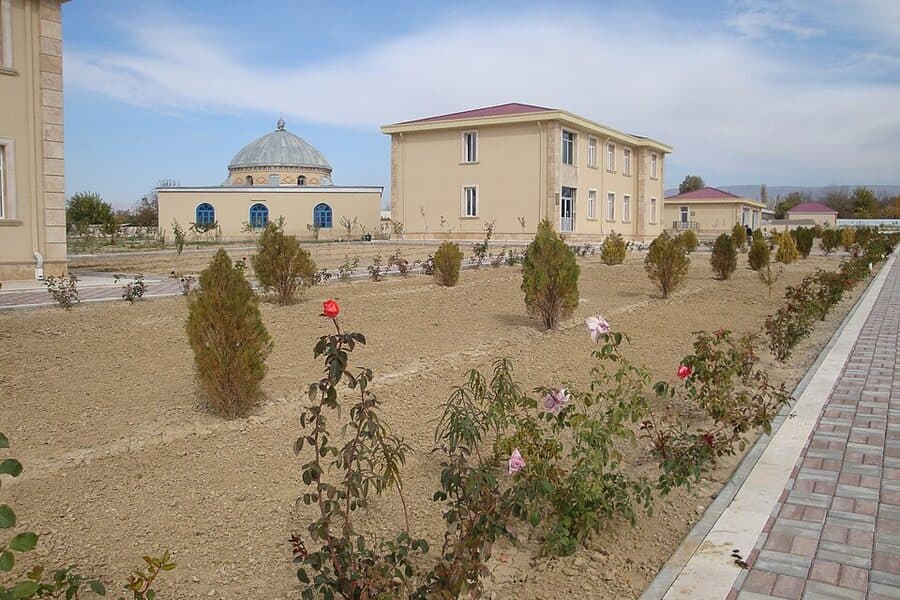
The most visible real estate activity is concentrated in Nakhchivan City itself, which has seen genuine urban renewal over the past two decades: new government and municipal buildings, renovated public squares, restored historical monuments, and a modest but steady supply of new apartment construction aimed almost entirely at local buyers — civil servants, professionals, and families with roots in the region. This is not speculative development aimed at outside investors; it is ordinary urban growth serving a population that, for demographic and economic reasons, is not expanding quickly. Outside the capital, in towns like Julfa, Ordubad, and Sadarak, the building stock is older and development activity is minimal, largely limited to family homes changing hands within local networks.
The Practical Logistics of an Exclave Market
Anything involving Nakhchivan starts with the same constraint: getting there means flying, since the Armenian border is closed and the alternative overland route through Georgia and Iran is impractical for routine travel. That single fact shapes everything downstream. Site visits require planning around AZAL's Baku-Nakhchivan flight schedule rather than a same-day drive. The pool of real estate agents, lawyers, and notaries actively working in the local market is far smaller than in Baku, and much of the market moves through personal networks and word of mouth rather than listed inventory or agency channels. Import costs for building materials and finished goods run higher than on the mainland, given the logistics of moving anything into an exclave whose main artery is a cargo hold or a long detour through Turkey or Iran. None of this makes property transactions here impossible — Azerbaijani law and property registration procedures apply uniformly across the country, including Nakhchivan — but it does mean the process takes longer, involves fewer intermediaries to lean on, and rewards buyers who already have a local contact or reason to be there.
Who This Market Actually Suits
Nakhchivan is realistically not a first stop for a foreign investor comparing yields across Baku neighborhoods. It suits a narrower set of buyers: people with family ties or heritage in the region looking to maintain or restore a family property; Azerbaijani nationals relocating for government, military, or administrative work tied to the exclave; small-scale investors interested in agricultural land or tourism-adjacent property connected to sites like the Duzdag salt sanatorium or the historical monuments around Nakhchivan City; and buyers explicitly seeking low entry prices and low competition over near-term liquidity or resale speed. Anyone expecting Baku-style price appreciation, a deep rental market, or an active resale pipeline should look elsewhere in Azerbaijan.
Due Diligence Looks Different Here
Standard due diligence still applies — verifying title, confirming registration with the State Committee for Property Issues, checking for outstanding liens or family claims on inherited property, and using a licensed notary for the transaction — but in Nakhchivan it has to be done with fewer professional resources on the ground and, often, more reliance on local knowledge than on a formal agency listing. Buyers should budget extra time for site visits given flight schedules, verify utility connections and access roads directly rather than assuming mainland-standard infrastructure, and treat any claim about future appreciation tied to the Zangezur Corridor with real caution: the corridor remains a matter of ongoing negotiation between Azerbaijan, Armenia, and outside parties, not a completed project, and its timeline is not something a buyer should build a financial plan around.
Takeaway
Nakhchivan is a real place with a real, if modest, property market — not a scaled-down Baku and not an overlooked investment frontier. It rewards buyers with a specific reason to be there and a tolerance for a thinner, slower, more locally-driven market, and it is honest to say so rather than oversell what is, for now, a niche corner of Azerbaijan's real estate landscape.
 Azerbaijan cities & regions
Absheron's Oilfields: From Contaminated Land to Regeneration
Tens of thousands of hectares left contaminated by the Soviet oil era, a World Bank rehabilitation programme, and the White City built on the Black City
Read more → Azerbaijan cities & regions
Buying Property Near Shahdag: A Guide to Azerbaijan's Ski Real Estate
Resort apartments and chalets around Shahdag Mountain Resort - rental yield potential from ski tourism, price comparison with the Alps, and what distant owners should know
Read more → Azerbaijan cities & regions
Buying Near Tufandag: Real Estate at Gabala's Ski Resort
Chalets, hotel-apartments and two seasons of demand - what buyers should know about property near Gabala's mountain resort
Read more →