Nabran: Azerbaijan's Original Caspian Beach Resort
Published on 2026-07-22 · 5 min read
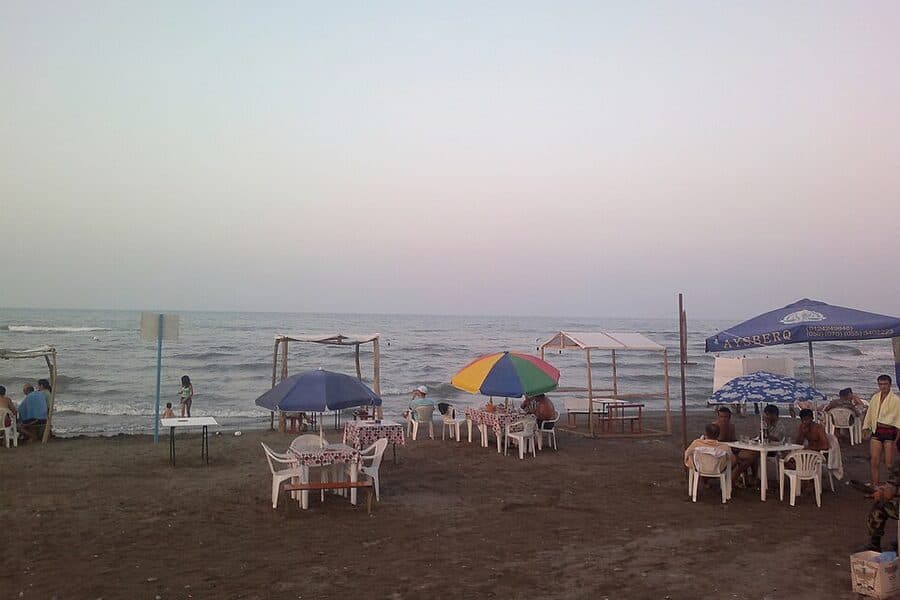
At the far northeastern edge of Azerbaijan, where the coastal plain narrows between the Caspian Sea and the last foothills of the Greater Caucasus, sits Nabran — a resort settlement in Khachmaz district that has functioned as Baku's summer beach escape for the better part of a century. Unlike the newer mountain and lake resorts that have opened elsewhere in the country over the past two decades, Nabran's identity as a holiday destination is old, deeply established, and built around a combination that is unusual for Azerbaijan: sandy Caspian beaches backed directly by dense pine and relict broadleaf forest.
From Fishing Village to Imperial Sturgeon Post
Nabran's origins have nothing to do with tourism. The settlement was founded around 1900 by Russian colonists relocated to the area under an order from the Russian imperial administration, with the specific purpose of fishing Caspian sturgeon destined for the imperial court. For decades, fishery remained the settlement's primary economic activity, and it was only from the 1970s onward, as Soviet planners began developing organized rest and recreation infrastructure along the Caspian coast, that Nabran's character shifted decisively toward tourism. That fishing-village history is still legible in the older parts of the settlement, even as sanatoriums, rest houses, and later private guesthouses came to dominate the local economy.
A Forest That Reaches the Sea
What sets Nabran apart from other stretches of Azerbaijan's Caspian coastline is its vegetation. The area sits within a humid microclimate distinct from the semi-arid Absheron Peninsula around Baku, and this, combined with extensive Soviet-era reforestation aimed at stabilizing coastal dunes, produced dense pine plantations that in places run right up to the sand. Mixed in with the pine are patches of older relict forest — beech, oak, hornbeam, and other broadleaf species — that give parts of the district a genuinely different feel from the dry, treeless coast most visitors associate with the rest of the country. The nearby Samur-Yalama National Park, established to protect the lowland riparian forest along the Samur River, extends this same ecological character north toward the border and is one of the few places in Azerbaijan where dense forest and Caspian beach sit side by side.
Sanatoriums, Rest Houses, and a Layered Hospitality Scene
Nabran's accommodation stock reflects its long history as an organized resort rather than an organically grown town. Soviet-era sanatoriums and departmental rest houses — originally built to serve workers from specific Baku factories, ministries, or trade unions — still make up a significant share of the district's beds, many of them since renovated or rebranded under private operators. Alongside these sit a growing number of newer hotels, guesthouses, and family-run boarding houses built specifically for the post-Soviet vacation market, along with children's summer camps that continue a tradition going back decades. The result is a hospitality landscape with more institutional depth than most of Azerbaijan's other beach areas, even where individual buildings show their age.
Distance From Baku and the Border
Nabran sits roughly 200 kilometers north of Baku along the M2 highway, a drive that typically takes between three and four hours depending on traffic through Sumgayit, Guba, and Khachmaz. The settlement is close enough to the Russian border that the Samur River, which forms the frontier with Russia's Dagestan republic, lies only a few kilometers to the north, and the Yalama border crossing — Azerbaijan's main land crossing into Russia along the Caspian route — is a short drive away. That proximity has long shaped Nabran's visitor profile: alongside Baku families making the classic domestic summer trip, the resort has historically drawn a meaningful share of visitors from Russia and other parts of the former Soviet space, for whom Nabran sits at a natural gateway point into Azerbaijan.
A Sharply Seasonal Economy
Nabran's economy runs almost entirely on a summer cycle. The resort fills from roughly June through early September, when Baku's own heat and humidity push residents toward the coast and the district's hotels, sanatoriums, and rental apartments reach or approach full occupancy. Outside that window, much of the settlement quiets considerably — many smaller guesthouses and seasonal food and drink operations close outright between October and May, and the resident population, put at only around two thousand people in the village itself, is far smaller than the summer visitor numbers would suggest. This is a defining structural feature of the area rather than an incidental one: Nabran was built, planned, and staffed as a summer destination, and its rhythms still follow that logic closely.
Beaches and the Caspian Shoreline
The beaches along Nabran's stretch of coast are sandy rather than pebbled, a distinction that matters on a Caspian coastline where shingle and rocky shore are common elsewhere. Most beach frontage is attached to specific hotels, sanatoriums, or rest complexes rather than organized as fully open public beach, a legacy of the district's institutional development, though the shoreline itself is long enough that access is rarely a serious constraint for visitors. The combination of shade from adjacent pine forest and a genuinely sandy shore is part of what has kept Nabran competitive against newer coastal developments closer to Baku.
Where Nabran Fits in Azerbaijan's Coastal Landscape
Compared to the dacha towns of the Absheron Peninsula just outside Baku, Nabran is farther away, more forested, and considerably more oriented around organized, multi-night stays rather than day trips or weekend house visits. Compared to newer mountain resorts like Gabala, it offers sea rather than elevation, and a tourism economy built over a full century rather than the past fifteen years. That combination — an old, forested, sea-facing resort at the northern edge of the country — remains one of the more distinctive entries on Azerbaijan's map of holiday destinations, and its position near the Russian frontier continues to shape both who visits and how the district's economy is organized around them.
 Azerbaijan cities & regions
Absheron's Oilfields: From Contaminated Land to Regeneration
Tens of thousands of hectares left contaminated by the Soviet oil era, a World Bank rehabilitation programme, and the White City built on the Black City
Read more → Azerbaijan cities & regions
Buying Property Near Shahdag: A Guide to Azerbaijan's Ski Real Estate
Resort apartments and chalets around Shahdag Mountain Resort - rental yield potential from ski tourism, price comparison with the Alps, and what distant owners should know
Read more → Azerbaijan cities & regions
Buying Near Tufandag: Real Estate at Gabala's Ski Resort
Chalets, hotel-apartments and two seasons of demand - what buyers should know about property near Gabala's mountain resort
Read more →