Eight Hotel Brands Announced. How Many Are Open?
Published on 2026-10-23 · 7 min read
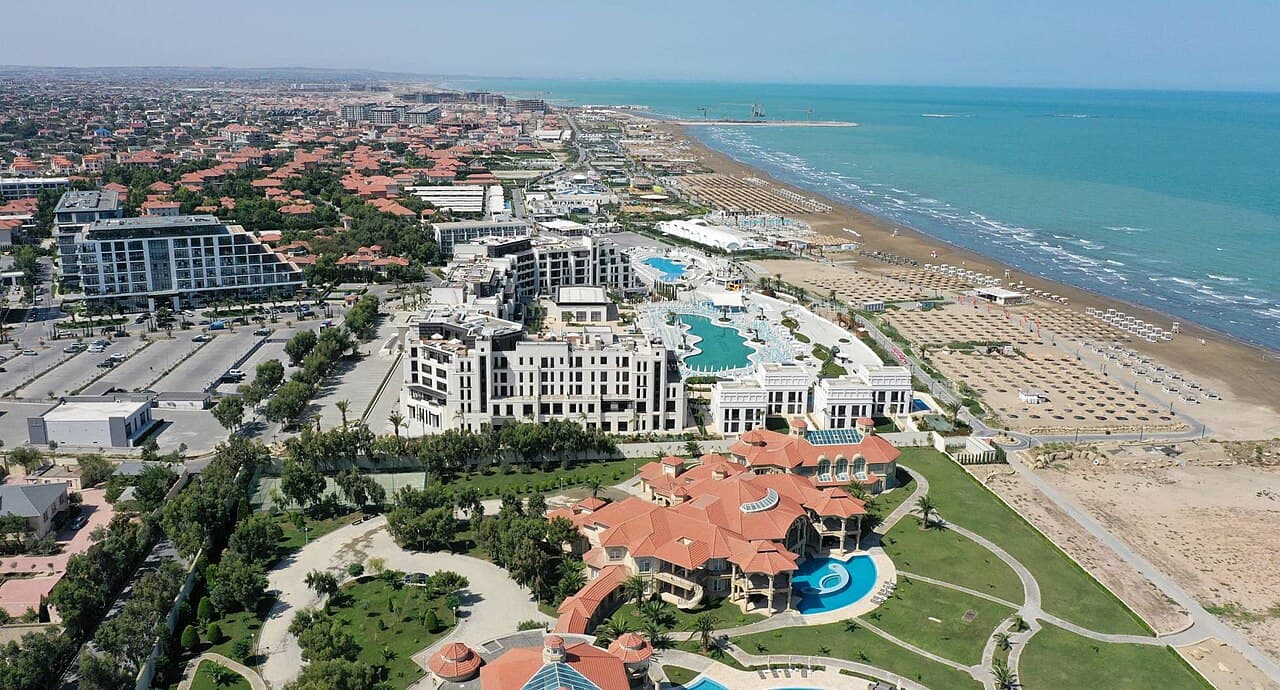
The hotel brand list is the most powerful sales tool Sea Breeze has. A buyer hesitating over a Caspian address stops hesitating when the names Cipriani, Nobu and Raffles enter the conversation. Branded hospitality is shorthand for due diligence done by somebody else: if Nobu is coming, the thinking goes, Nobu must have checked.
This page checks instead. It separates the brands with a documented agreement from the brands that appear only in marketing, and it counts how many are actually operating. The answer to the headline question, as of October 2026, is zero.
The Audit
| Brand | Status in public sources | Opening date |
|---|---|---|
| Cipriani | Agreement signed January 2026. Tower stated at 323 m on Half Moon, by Killa Design | None published |
| Nobu | Announced October 2025. 80 rooms, 100 residences including 5 villas | None published |
| Raffles | Project by Melike Altinisik Architects: 13 storeys, 150 keys, 458 residences | None published |
| Swissotel | Same scheme as Raffles | None published |
| Hilton | Appears in resort marketing and sales-partner material | Not found |
| Marriott | Named for the Half Moon artificial peninsula, which its contractor says is under construction | Not found |
| Radisson | Appears in sales-partner brand lists | Not found |
| Hyatt | Appears in sales-partner brand lists | Not found |
Two of the eight have a dated, attributable agreement. Two more have an architect and a published programme, which is strong evidence of a real project. Four appear as names on lists, with no agreement, no architect, no programme and no date that we could verify.
The Founder's Own Number
In an interview with Report.az on 26 September 2026, Emin Agalarov said Sea Breeze had signed "around 20 agreements with various names" for branded residences and was continuing to expand the list.
That figure cuts both ways, and both ways are useful.
It suggests the pipeline is real and larger than the eight names above - there are agreements the public has not seen. It also reframes what an agreement is worth. If roughly twenty brand agreements exist and zero branded hotels are open, then a signed agreement at this resort is an early-stage document, not a commitment with a date. In the same interview Agalarov put overall progress at only 10-15% of planned work, with seven to eight years to implement everything designed. A brand pipeline sitting on top of a resort that is one-eighth built is a pipeline measured in years.
Why "Announced" and "Open" Get Confused
Three mechanisms blur the distinction, none of them unique to Sea Breeze.
Hotel deals are genuinely slow. Signature to opening is routinely four to seven years for a new-build resort hotel. A 2026 agreement opening in 2031 is not a failure; it is the industry's normal clock. The problem is that the sales conversation happens in the present tense.
The brand is licensed, not built. A hotel brand usually signs a management or franchise agreement. It does not fund the building. If the developer slows down, the brand waits, and the brand's own announcement stays online.
Residences and hotels are announced as one thing. Raffles at Sea Breeze is 150 hotel keys and 458 residences. The residences are what is sold to buyers; the hotel is what lends the name. Those two components can be built in either order, and the residence buyer's amenity promise depends on the hotel half arriving.
The Correction Everyone Repeats
One brand belongs in no Sea Breeze list: the Ritz-Carlton beach resort near Baku is at Zagulba, not Sea Breeze. It is a separate 80-room project with 282 adjoining residences, under different ownership, several kilometres up the coast. It appears in Sea Breeze conversations because it is the same coastline and the same news cycle. If a seller includes Ritz-Carlton in a Sea Breeze amenity list, that is the moment to ask which other names on the list are also not theirs.
What a Brand Agreement Actually Guarantees
Buyers assume a hotel brand underwrites the project. In almost every case it does the opposite: it lends a name and takes a fee, while the developer carries the capital risk alone.
A typical arrangement is a management agreement. The brand operates the hotel once built, applies its standards, supplies its reservation system and takes a percentage of revenue. It does not finance construction, does not guarantee the delivery date, and is generally free to walk if the developer fails to meet the construction and quality milestones in the contract. The agreement protects the brand's reputation first, which is exactly why brands sign them early - the downside of a stalled project falls on the developer and the buyers, not on the brand.
For a residence buyer, three clauses in that structure matter and none of them are in the brochure. Whether the branding applies to your building or only to the hotel tower. Whether the brand can terminate, and what the residences are called afterwards. And whether the service package you were shown - housekeeping, concierge, pool access - is contractually owed to residences or is a hotel service the hotel may price separately once open.
The Nobu Case, Read Closely
Nobu is the most precisely specified brand in the pipeline, which makes it the best worked example.
The October 2025 announcement gave a programme that is unusually exact: 80 guest rooms, 100 residences including five villas, with a Nobu restaurant at the centre of the scheme plus spa, fitness, meeting space and recreation. That specificity is a good sign; it suggests real design work rather than a letter of intent.
What the announcement did not give - and what a year of subsequent coverage still has not given - is an opening date. For a buyer, that combination is the whole lesson of this page in one project: the brand is real, the programme is real, the design is probably real, and the date does not exist. Anyone quoting you a Nobu opening year is quoting themselves.
The restaurant is worth isolating too. A Nobu restaurant can open years before a Nobu hotel, and in a resort context the restaurant is what residents actually use. If the amenity that matters to you is dinner rather than room service, ask which component opens first - the answer is sometimes the good news the developer has not thought to give.
What This Means for a Buyer
Price the brand at zero until it opens. If the hotel is the reason you are paying a premium, you are paying today for an amenity with no published date. Our page on branded residences and what the premium buys covers how these agreements are structured.
Ask for the agreement's status in writing. The questions that have answers: is there a signed management agreement, what is the contracted opening year, and is the brand's obligation conditional on construction milestones the developer has not yet met? A developer with a firm deal will say so.
Check whether your building depends on the hotel. Shared pools, spas, restaurants and concierge service in a hotel-and-residence scheme are usually in the hotel component. If the hotel is delayed, the residences complete without the amenities that justified the price.
Treat the four unverified names as absent. Hilton, Marriott, Radisson and Hyatt may well arrive. Today they are strings of text on sales material, and a brochure is not a lease.
How to Read This List in Two Years
The useful thing about an audit is that it dates itself. Three signals will tell you the pipeline is converting: a published opening year for Nobu, visible superstructure on Half Moon for the Cipriani tower, and recruitment advertising for hotel staff. The third is the most reliable and the least discussed - hotels hire roughly six to nine months before opening, so a general manager vacancy posted for Sea Breeze is better evidence than any press release.
Until then, the honest summary is that Sea Breeze has assembled an unusually strong brand pipeline for the Caspian and has not yet opened any of it. Both halves of that sentence are true, and a sales conversation that gives you only the first half has told you something about itself. Our project inventory and delivery-date audit track the same distinction across the residential side.
 New developments
Apartment Types and Layouts at Miami Residence: What's Publicly Known
A general look at what is publicly described about unit types and layouts at Miami Residence, and what buyers should verify directly with the developer
Read more → New developments
The Architecture of Miami Residence in Baku: Five White Towers on the Caspian
A closer look at the architectural style of Miami Residence — European-minimalist design, panoramic windows, and a Miami-inspired aesthetic on the Caspian coast
Read more →New developmentsThe Design Details Behind Miami Residence: Ceiling Height, Light, and Layout
A closer look at the design choices that distinguish Miami Residence - 5-meter ceilings, panoramic windows, and natural light - and what they mean in practice
Read more →