Duzdag: the hospital 110 metres inside a salt mountain
Published on 2026-10-23 · 5 min read
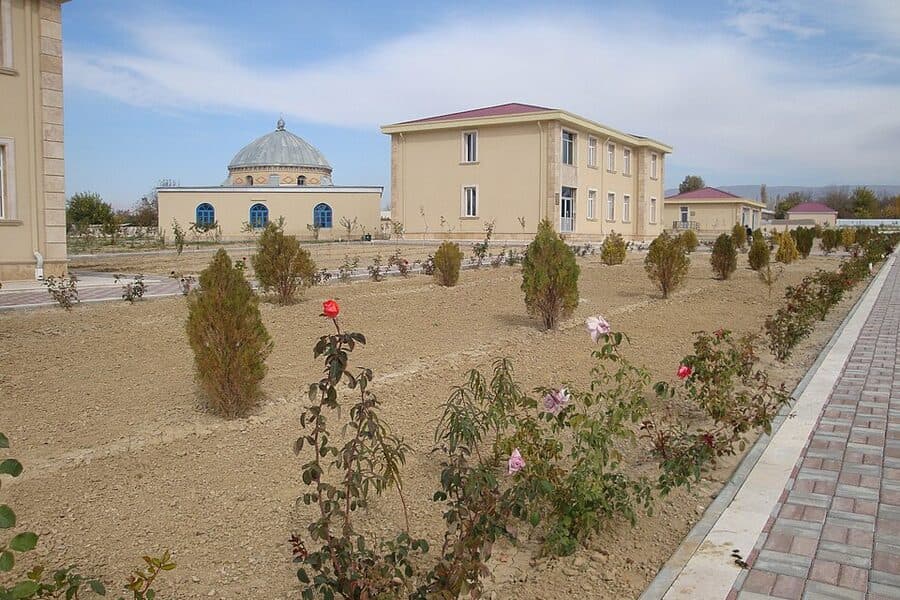
Most visitors treat Nakhchivan as a stop rather than a stay. The thing most likely to change that is eleven kilometres outside the city and 110 metres underground: a working respiratory clinic inside a salt mountain, with a hotel attached.
A salt mine that became a hospital
The chambers were cut for salt, and they are old - the workings were first hollowed out almost 5,000 years ago. The medicine is recent. The Duzdag Physiotherapy Centre was established on 29 December 1979 and opened in March 1980 as part of Babek Central Hospital, covering some 15,000 square metres. The hotel and sanatorium complex above ground was inaugurated in June 2008.
Patients breathe the air rather than take anything. The centre treats bronchial asthma, chronic bronchitis, pollinosis and allergic rhinitis, and added a post-Covid respiratory rehabilitation programme. Those are the conditions the centre itself lists; this page is not a medical source and does not assess whether the treatment works.
The numbers that agree, and the one that does not
| Figure | Value |
|---|---|
| Depth below ground | 110 m (360 ft) - our reading, see below |
| Altitude of the site | 1,173 m |
| Thickness of the salt wall | 8.2 m |
| Underground temperature | 18-20°C |
| Underground humidity | 20-25% |
| Capacity | 474 patients |
| Patients per year | 3,500-4,000, mostly in summer |
| Distance from Nakhchivan city | about 11 km |
The depth is the figure to be careful with. Travel write-ups circulate 300 metres and 350 metres. Two sources that state it with a conversion both give 110 metres, and nothing we opened supports the larger numbers - they most likely describe how far the tunnels run into the mountain rather than how far below the surface the chambers sit. Those are different measurements, and only one of them is depth.
474 beds, 4,000 patients a year
Euronews calls Duzdag the largest health tourism facility in the region. Set the two published figures against each other and a different picture appears.
474 beds across a full year is about 173,000 bed-nights of capacity. Three to four thousand patients a year cannot fill that: even on a generous assumption of a three-week stay each, it comes to under half. The constraint on Duzdag is not space. It is demand, and it is seasonal - the published pattern is that patients come mostly in summer, which leaves the rest of the year quiet.
The second comparison is sharper, and official data now dates it properly. Nakhchivan recorded 3,129,789 overnight stays in 2025, per State Tourism Agency figures. Patients and stays are not the same unit - one counts people, the other nights - so convert: even on a generous three weeks each, 3,750 patients account for roughly 79,000 nights, about 2.5% of the republic's recorded nights. At a fortnight each it is 1.7%.
The seasonal demand constraint is now corroborated rather than inferred. Nakhchivan's overnight stays fell 37.0% in the first quarter of 2026 against the same quarter of 2025, part of a pattern across every regional destination that our tourism divergence analysis sets out. For historical context, the older series put tourist numbers at 413,357 in 2017 against 93,930 in 2006. The mine is not what most people come for, and it is not crowded when they do.
For a visitor that is good news: a famous place you can have largely to yourself. For anyone reading tourist volume as short-let demand, it is a caution - and it is why we treat Nakhchivan differently from Baku in our guide to buying there.
What fills the second day
Two more places carry a full extra day, and both are properly documented.
Alinja Castle, about 35 kilometres from Nakhchivan city, sits on top of a rock at roughly 1,800 metres and is reached by 1,500 stone steps - about 45 minutes up. It is the site routinely called the Machu Picchu of the Caucasus. Its age is unsettled: it is first mentioned in first-century sources, described elsewhere as sixth-century, and what stands today is substantially a modern reconstruction after conservation work in the 2010s. One visitor review claims nearer 3,000 steps; we could not confirm that against anything better.
Lake Batabat, in the Shahbuz district, sits at 2,500 metres and is visited year-round by local operators.
Getting there
Nakhchivan is an exclave: roughly 420 kilometres west of Baku, with no Azerbaijani road connecting the two. You fly. That single fact shapes everything about visiting - and about the property market, which our Nakhchivan overview sets out.
Sources
- CNN Travel, "Duzdag: the health spa hidden deep in a salt mine on the edge of Asia", Camilla Rzayeva, 30 December 2023, read via syndication 23 October 2026 - depth, altitude, salt wall thickness, 1979 founding, 2008 hotel, 474 capacity, temperature, humidity, 3,500-4,000 patients a year, distances, conditions treated.
- Euronews, "Going underground: discover Nakhchivan's wellness culture, 110 metres below ground", 28 October 2025 - depth, "largest health tourism facility in the region", Lake Batabat at 2,500 m in Shahbuz.
- Wikipedia, "Tourism in Nakhchivan Autonomous Republic", read 23 October 2026 - centre established 29 December 1979 and opened March 1980 within Babek Central Hospital, about 15,000 m², sanatorium complex June 2008, tourist numbers 2006-2017, Alinja at about 1,800 m.
- Outlook Traveller, updated 7 December 2024 - Alinja's 1,500 steps, 45-minute climb, 35 km distance, first-century mention.
- State Tourism Agency of the Republic of Azerbaijan - Nakhchivan's 3,129,789 overnight stays in 2025 and the 37.0% fall in Q1 2026, released to Modern.az and published 21 August 2026. Read 24 October 2026.
Not verified: the length of a standard treatment course, current prices, and whether any figure here has been updated since 2017 for tourist numbers or since 2023 for patient numbers. The 300 m and 350 m depth figures in circulation are not supported by any source we opened.
 Azerbaijan cities & regions
Buying Property in Nabran: A Practical Guide
Guesthouses, small hotels and holiday apartments - what to know about investing in Azerbaijan's most established Caspian beach resort
Read more →Azerbaijan cities & regionsProperty and Investment in Nakhchivan: A Realistic Look
Nakhchivan is not Baku's next frontier - it's a small, isolated exclave economy with its own rules. What real estate and investment actually look like there
Read more → Azerbaijan cities & regions
Buying Property in Quba-Qusar: A Practical Guide
Orchard land, mountain village houses, and Shahdag-driven resort development - what foreign buyers should know about this rural, mountainous market
Read more →