Why You Can't Swim in Baku Bay — and Where You Can
Published on 2026-09-15 · 6 min read
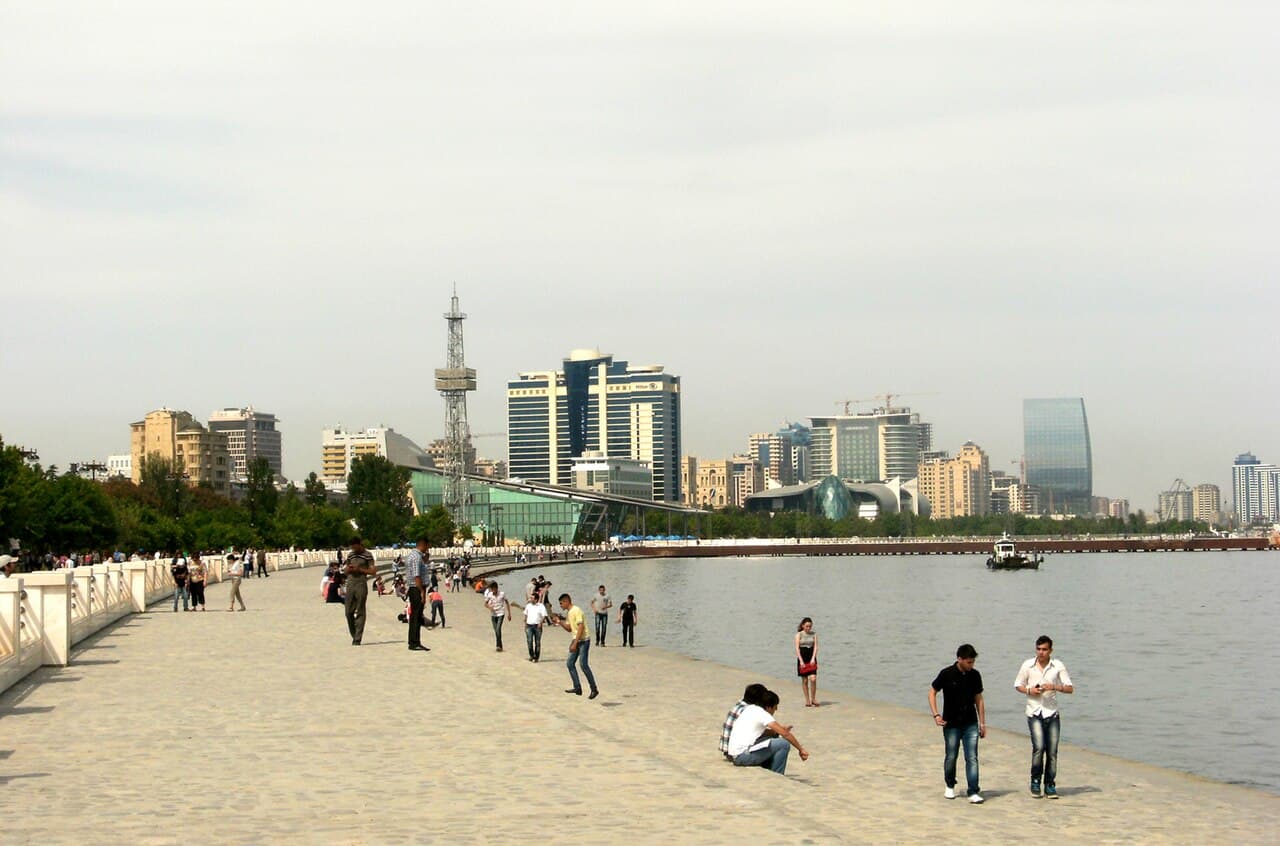
You are standing on Baku's Boulevard in July, the Caspian stretches out in front of you, the heat is punishing - and nobody is in the water. It is one of the first things that confuses visitors to the city. The answer is straightforward: swimming in Baku Bay is prohibited, and not because of currents or jellyfish. This is a traveller's question, but it is also the first question anyone considering a property on the Absheron coastline has to answer - because water quality here is not a property of "the Caspian Sea" but of a specific point on the map.
One bay, two separate problems
Baku Bay is a semi-enclosed, horseshoe-shaped bay, and that shape is part of the problem. Water in an enclosed bay exchanges far more slowly than along an open coast, so whatever enters it stays longer. On this bay sit an active port, long-established heavy industry, and the drainage system of a city of millions.
The problems divide into two, and it is worth separating them because they behave differently. The first is sewage - domestic and industrial, some of which reached the sea over the years without adequate treatment. The second is oil, and it is much older.
The oil that is still on the water
At the south-western end of the bay sits Bibi-Heybat, one of the oldest oil fields in the world. Drilling has been going on there since the nineteenth century, and the derricks are visible from the shore with the naked eye. This is not a heritage site - it is a working field.
The practical consequence is familiar to anyone living nearby: when the wind blows from the right direction, it carries a thin film of fuel onto the shore. Not a dramatic slick, but an oily sheen that appears and disappears. It is one of the main reasons for the recurring swimming bans in the area.
Alongside this runs a wider Soviet legacy: old abandoned wells across the Absheron Peninsula continue to leak, and the UN Environment Programme describes the Caspian as carrying a heavy pollution burden from oil extraction and refining, offshore fields, and large volumes of untreated sewage - most of which arrives via the Volga from the north rather than from Azerbaijan.
Shikhov: the beach that closes most years
About ten kilometres south of central Baku, next to that same oil field, is Shikhov Beach. The Republican Centre for Hygiene and Epidemiology declares it unfit for bathing in most years, and ecologists have warned about the presence of E. coli in the water.
Other beaches in the same stretch - Sahil and Hovsan among them - have also been closed to swimming intermittently, for the same combination of untreated discharge and industrial proximity.
It is worth being precise here: this does not describe Azerbaijan, and it does not describe the Caspian Sea. It describes a specific stretch of coast, a few tens of kilometres long, on one side of a peninsula.
The other side of the peninsula
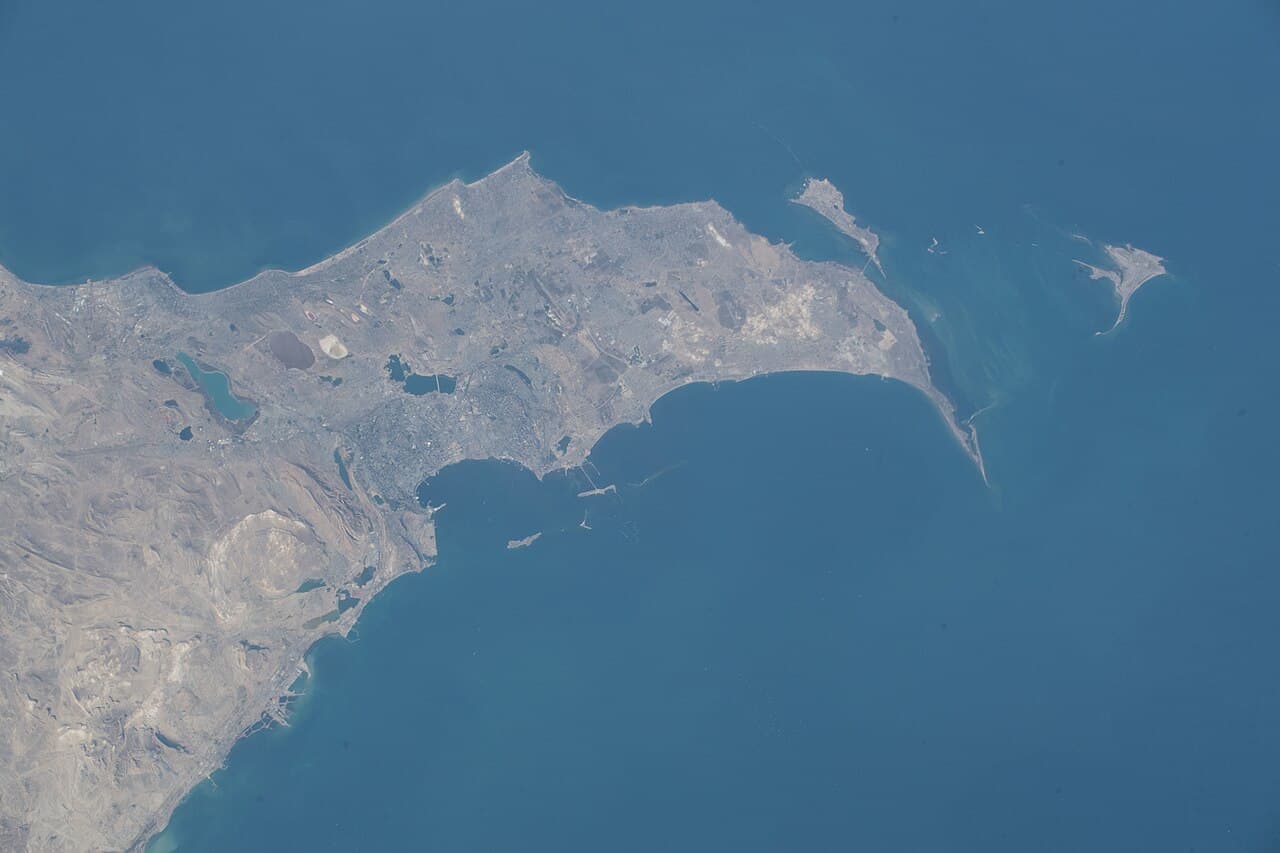
The Absheron Peninsula juts eastward into the sea, and its northern and north-eastern coast has none of the bay's problems: no enclosed basin, no port, no working oil field on the waterline, and treatment facilities in place.
The Ministry of Ecology and Natural Resources has confirmed that no sewer pipes drain into the sea at Bilgah, Buzovna, Mardakan, Pirshagi and Nardaran - and the same applies to Amburan beach and the Novkhani and Jorat shorelines. It is a specific list, and worth knowing before planning a day at the sea.
| Area | Status | Why |
|---|---|---|
| Baku Bay / Boulevard | Swimming prohibited | Enclosed bay, port, city drainage |
| Shikhov, Sahil, Hovsan | Repeated closures | Oil field proximity, discharge |
| Bilgah, Buzovna, Mardakan | Clean | No sewer outfalls, treatment facilities |
| Nardaran, Pirshagi | Clean | No sewer outfalls |
| Novkhani, Turkan | Varies | No outfalls, but failed 2025 monitoring |
| Two different measures, and they do not always agree. "No sewer pipe" is a fact about infrastructure; "the water is clean" is a test result. They are not the same thing. In monitoring carried out by the Ministry of Ecology in late June and early July 2025, sea water at Bilgah, Nardaran, Buzovna, Mardakan, Shuvalan, Zagulba and Pirshagi was found suitable for use - while Novkhani, Turkan, Hovsan, Shikhov, Sahil and Sumgayit were found unsuitable due to microbiological pollution. Novkhani appears on both lists: it has no direct outfall, and it still failed the test. Which is precisely why a current check beats any list. |
The distance between the bottom two rows and the top two is a drive of under an hour.
How to check before you go in
Since 2026 the Ministry of Ecology has run a Telegram bot that lets you check bacteria levels at beaches before setting out. It is the simplest and most current tool available, and it beats any general recommendation - including this one, which describes a pattern rather than a measurement on a given day.
Three practical checks worth making anyway: confirm there is a lifeguard and the beach is maintained, look for drilling derricks within sight, and notice whether locals are going in. The third is usually the most reliable.
What this map means for waterfront property
This is where the distinction stops being a traveller's curiosity and becomes an economic fact. If water quality on the Absheron Peninsula is determined by location - not by season, weather or luck - then for anyone assessing a coastal property, which side of the peninsula it sits on is not an aesthetic preference but a material attribute of the asset.
That cuts both ways. A property on a stretch where bathing is banned each summer loses its peak season as a holiday asset, and that shows up in occupancy and in rent. A property where the water stays clean through the season benefits from genuine tourist demand in precisely the months when the short-term rental market earns.
The Sea Breeze development, for instance, sits at Nardaran - on that same northern stretch the Ministry lists as free of sewer outfalls. That is not a marketing claim but a point of geography, and it explains why large-scale resort development grew up there rather than on the bay.
Anyone weighing a waterfront purchase can compare the coastal areas side by side in the neighbourhood comparison tool - and water quality belongs in that table as a row, not as an impression.
Related articles
 Living & visiting guide
The Absheron Peninsula Water Quality Map
What the Ministry of Ecology's monitoring found suitable and what it did not, why the infrastructure list and the test results disagree, and how the Khazri wind changes things
Read more →Living & visiting guideBaku Beaches: A Practical Guide to the Coast
Bilgah, Buzovna, Mardakan, Novkhani and Amburan - what to expect at each beach, how to get there, and why some charge entry when the law says they are free
Read more → Living & visiting guide
Novruz Bayram in Baku: A Complete Spring Festival Guide
Novruz Bayram, the Azerbaijani spring festival — when it falls, its customs, its effect on the city and what it means for property owners and investors in Baku
Read more →