The Caspian's Oil Legacy: Where the Pollution Comes From
Published on 2026-09-24 · 4 min read
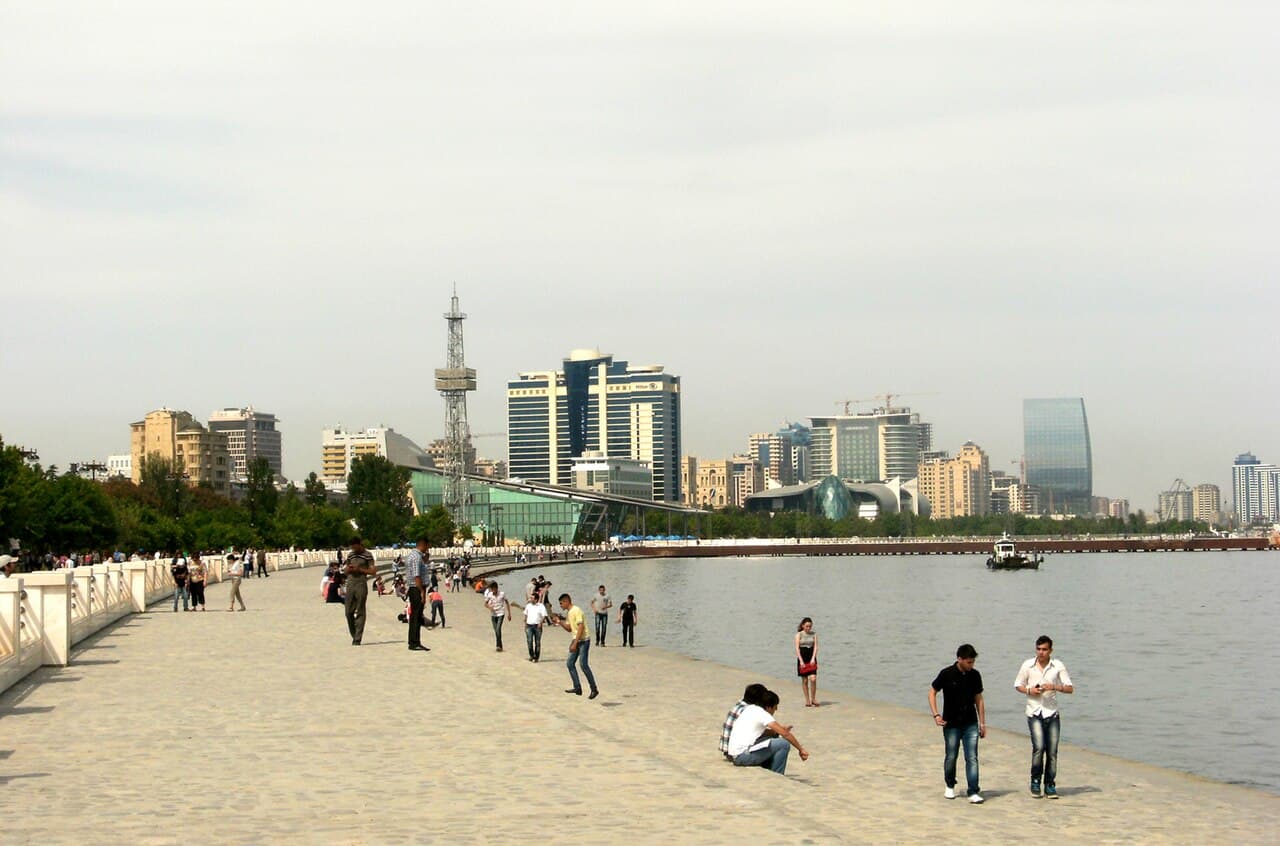
"The Caspian is polluted" is both true and useless. It distinguishes nothing - not sources, not areas, not types of contamination - and so it helps nobody decide where to travel or where to buy. Taking it apart is far more interesting than the headline, mainly because it leads somewhere counter-intuitive: most of the pollution does not come from Azerbaijan.
What enters the sea
The UN Environment Programme describes the Caspian as carrying a heavy pollution burden from several distinct sources:
Oil extraction and refining - the long-established industry that has operated around the sea for over a century.
Offshore fields - drilling within the sea itself.
Radioactive waste from nuclear facilities.
Huge volumes of untreated sewage - and this is the largest component.
The point that changes the picture
The untreated sewage arrives mainly via the Volga, from the north.
The Volga is Europe's largest river, draining an enormous basin that takes in many industrial cities across Russia. It empties into the Caspian at its northern end, carrying with it whatever it has gathered along the way.
Which means the sea's environmental burden is not set in Baku. Azerbaijan contributes its share - particularly through Absheron's industrial legacy - but it is neither the principal source nor the party that controls it.
That absolves nobody, and it certainly does not mean the water is fine everywhere. It does explain why this is a problem five countries have to solve together, and why no single country can solve it alone.
The local legacy: wells that still leak
Alongside what arrives from outside there is what remains from home.
Old abandoned oil wells across the Absheron Peninsula continue to leak. At the south-western end of Baku Bay, the Bibi-Heybat field has been producing since the nineteenth century, and its derricks are visible from the shore. When the wind sits in a particular quarter, it carries a thin film of fuel to the waterline.
We covered the land side of the story - tens of thousands of contaminated hectares and the rehabilitation programme - in Absheron's oilfields.
A shrinking sea makes all of it worse
There is a compounding factor here that gets too little attention.
The Caspian is losing water. Since the mid-1990s its level has fallen by roughly two metres, putting it at its lowest in 400 years, at a rate of 9 to 35 centimetres a year.
The logic is simple: the same quantity of pollutants in less water is a higher concentration. A shrinking sea is not only a problem of a retreating shoreline - it is also a problem of diminishing dilution.
This is one reason water quality is something to track over time rather than check once.
Why nobody fixes this alone
The Caspian borders five countries: Azerbaijan, Russia, Kazakhstan, Turkmenistan and Iran. It has no outlet to an open ocean, which means nothing that enters it is flushed out.
An inter-state framework convention for protecting the Caspian's marine environment exists, but the problem identified repeatedly in analyses is not the absence of a framework - it is fragmented decision-making across the five states. The same analysis that explains the falling level points to that fragmentation as a central driver, alongside the damming and diversion of rivers.
For a reader trying to assess the trend, the implication is that real improvement requires coordination beyond any one country's borders, and is therefore slow. Local investment in treatment facilities or land remediation is real and useful - but it works on one part of the equation.
What this does and does not mean
It does not mean the Caspian is dangerous to swim in. It means water quality varies sharply by location and has to be checked site by site. What we found in the water quality map is exactly that: in one season, beaches found suitable and beaches found unsuitable, a short distance apart.
It does mean that the long-term trend is not within Azerbaijan's sole control, and that every local improvement - treatment plants, land remediation, enforcement - operates against a backdrop set elsewhere.
What this means for someone weighing a coastal property
The practical conclusion is neither avoidance nor indifference.
A coastal property on Absheron is exposed to two entirely different things. The first is local and checkable: what is on this stretch of shore, whether there is drainage, what the testing showed. That is what you examine before buying, and it varies greatly from place to place.
The second is regional, and outside the control of anyone you can call: the state of the sea overall, its level, and the burden arriving via the Volga. That is a background risk applying equally to every property on the Caspian, whether in Baku, Kazakhstan or Iran.
The distinction matters because it directs attention. There is no point comparing beaches in Baku on a factor that applies to all of them equally. There is every point comparing them on the local factor, where the differences are real and measurable. That comparison can be made in the neighbourhood comparison tool.
Related articles
 Living & visiting guide
Family-Safe Beaches Around Baku
Which beaches suit young children, what to check before going in, why the Caspian is actually convenient for families, and how managed venues differ for this purpose
Read more → Living & visiting guide
The Caspian Swimming Season: When the Water Is at Its Best
Baku's sea temperatures month by month, when the season opens and closes, why August is the peak, and what the Khazri wind does to the sea the rest of the year
Read more → Living & visiting guide
The Absheron Peninsula Water Quality Map
What the Ministry of Ecology's monitoring found suitable and what it did not, why the infrastructure list and the test results disagree, and how the Khazri wind changes things
Read more →