Sea Breeze Beach vs a Public Beach in Baku
Published on 2026-09-15 · 5 min read
Having established where you are allowed into the water and gone through the beaches one by one, one comparison remains, and it is the one most people ask about: a managed resort beach versus a public one. It is a question about a day at the sea - but it is also a question about property, because those two models generate two entirely different kinds of demand.
First, a point worth making honestly
The water is the same water.
Sea Breeze sits at Nardaran, on the northern shore of the Absheron Peninsula. On that very same stretch of coast are Buzovna, Bilgah, Mardakan and Pirshagi - settlements with public beaches. The Ministry of Ecology and Natural Resources lists all of them together: areas where no sewer pipes drain into the sea.
In other words, the difference between a managed resort beach and a public beach on the northern side is not a difference in water quality. Anyone selling it to you that way is selling you something imprecise.
The real difference is everything layered above the water.
What a public beach does better
It is worth starting on this side, because it usually gets lost in the marketing.
Cost. Entry is free, or substantially cheaper. For a family going to the sea ten times over a summer, the cumulative difference is not trivial.
Local atmosphere. Buzovna and Mardakan are living settlements, not facilities. Anyone after the feel of a real place rather than a resort will find it there.
Flexibility. No gate, no opening hours, no dress code or house rules. Arrive when you like, leave when you like.
You are not paying for what you do not want. Pools, clubs and restaurants are value only to those who use them.
What a managed venue does better
Certainty. This is arguably the central advantage. At a public beach you find out on arrival what is there - whether there is shade, whether there is a lifeguard, whether it is clean. At a managed venue you know in advance.
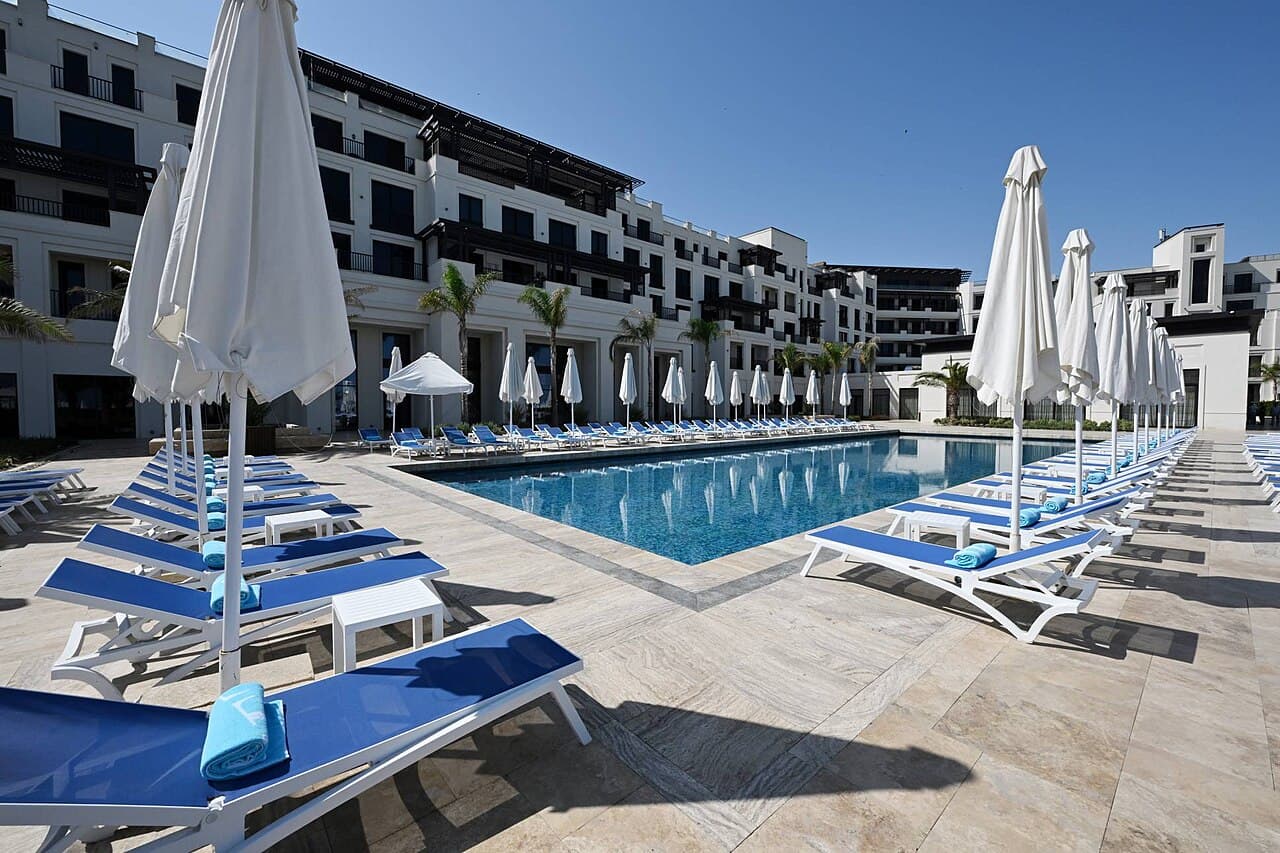
Infrastructure. At Sea Breeze, the White Beach Club operates with around 250 places on the beach - sun loungers with umbrellas, tents and gazebos - alongside a terrace restaurant and an adjacent event hall. The wider resort has three outdoor pools with seating areas and bars, plus two further covered pools for children, as well as a fitness room, a yoga studio, a spa, restaurants, boutiques and a market.
Shade and organisation. Remember that shade is scarce on the free stretches. At a managed venue it is part of the product.
Distance. Nardaran is about half an hour from central Baku - broadly in line with the other coastal settlements.
The comparison in a table
| Public beach | Managed venue | |
|---|---|---|
| Water quality | Same on the northern side | Same on the northern side |
| Cost | Free or cheap | Entry fee or membership |
| Shade and facilities | Not guaranteed | Part of the product |
| Certainty in advance | Low | High |
| Atmosphere | Village, local | Resort |
| Flexibility of hours | Total | Per house rules |
| Ancillary services | Few | Restaurants, pools, spa |
So who suits which
The honest answer is that it depends on frequency and life stage, not on which is "better".
Someone who goes to the sea a few times a season, knows the area and needs nothing handed to them will get exactly what they want from a public beach, without paying for the rest.
Someone arriving with small children, someone hosting guests, someone who does not want to gamble on what they will find on arrival, and someone staying in the area for a stretch rather than a day - will find the certainty worth the price.
Two models, two kinds of tenant
This is where the comparison stops being a question about a day at the sea.
Anyone assessing a property on the northern coast is in practice choosing not just a location but a model, and the model determines who rents from them and when.
A property in a traditional coastal settlement - Buzovna, Mardakan, Bilgah - speaks mainly to local, seasonal demand: families from Baku moving out for the summer, longer lets in the warm months, and lower entry prices on purchase too. This is the historic dacha belt, and it works on its own logic.
A property inside a managed resort speaks to different demand: short stays, tourism, guests who come for the infrastructure and not only for the sea. Occupancy there rests on an events calendar, on restaurants and on services - which makes it less dependent on any given day's weather, but more dependent on the venue itself continuing to function and fill.
That is a genuine trade-off, not a victory for one side. The managed model reduces exposure to the season and increases exposure to the operator. The traditional model does exactly the reverse.
Anyone trying to work out what that means in practice in terms of costs - upkeep, services, living expenses in the area - can start with the currency and cost of living calculator.
A note
Details on facilities, capacity and entry conditions vary between seasons and between venues, and are worth verifying directly before travelling or before deciding. The information here describes what was known as of September 2026.
Related articles
 New developments
Who Is Hagag Group? The Israeli Developer Entering Sea Breeze in Baku
A factual look at Hagag Group, the publicly-traded Israeli developer that signed a memorandum of understanding for a project within Sea Breeze in Azerbaijan
Read more → New developments
Hagag Group in Israel vs. Baku: What the Move Into a New, Unconfirmed Deal Actually Means
A factual comparison of Hagag Group's established Israeli track record against its new, non-binding memorandum for two projects at Sea Breeze in Azerbaijan
Read more →New developmentsHagag Group Signs MOU for Major Sea Breeze Development
Israeli developer Hagag Group has signed non-binding memoranda of understanding for two residential projects totaling roughly 3,500 units at Sea Breeze, pending due diligence
Read more →