How Clean Water Became Sea Breeze's Tourism Engine
Published on 2026-09-24 · 5 min read
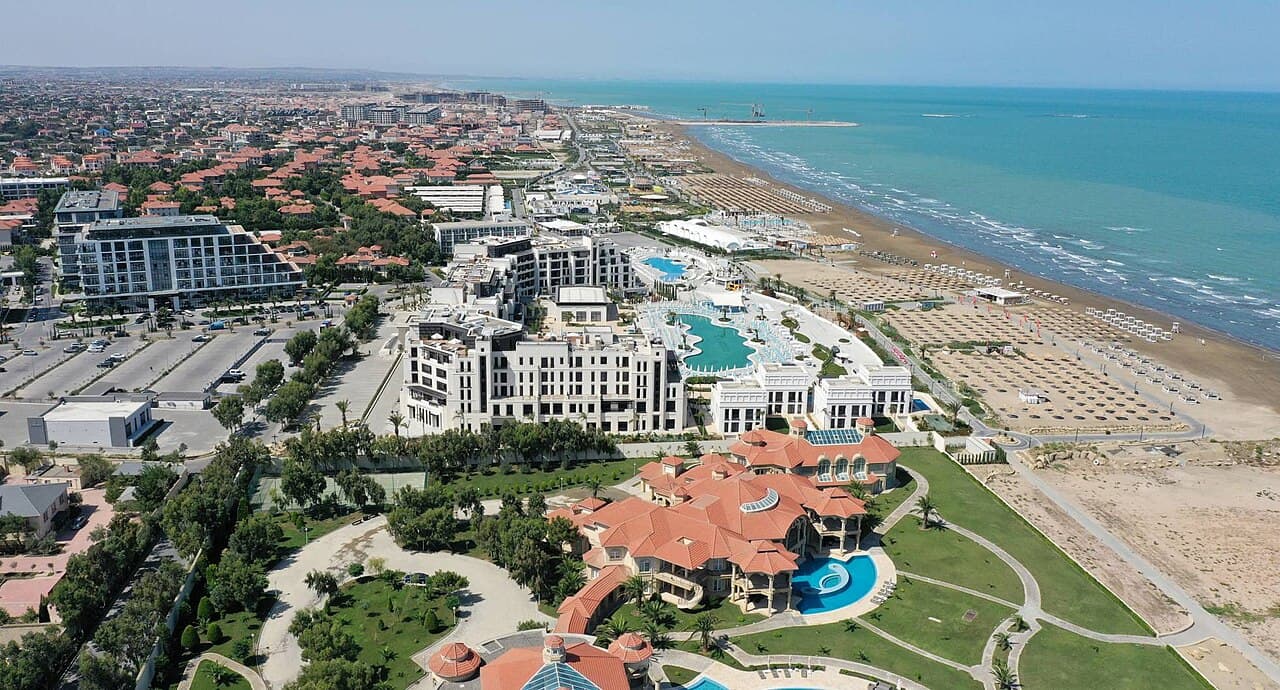
There are two figures here that appear to contradict each other, and the contradiction is the story.
The Sea Breeze area received more than 100,000 visitors in the last summer season. And over roughly the same period, total foreign arrivals to Azerbaijan in January-July 2026 fell about 9.2% against the comparable period, while foreign tourist spending dropped from around 2 billion manat to roughly 1.55 billion.
One area grows while the national market contracts. Why?
The first explanation: the water
This is the obvious explanation, and it is partly right.
Baku is a problematic beach destination. Swimming in the bay is banned, and several beaches to the south-west close intermittently. Someone who arrives at a seaside destination and finds they cannot go into the water does not return, and does not recommend.
The northern side of the peninsula is different. We covered it in the water quality map, particularly the gap between what infrastructure promises and what testing finds.
What that means: in an area where water quality is not a given, a beach you can safely enter is a genuine differentiator rather than a slogan.
The second explanation, and the more important one: certainty
But clean water alone does not explain a hundred thousand visitors.
What does explain it is what we wrote in the managed versus public beach comparison: at a managed venue you know in advance what you will find. Shade, a lifeguard, toilets, somewhere to eat, pools. At a public beach you find out on arrival.
For a tourist who has travelled a distance, is planning one day, and does not know the area - that certainty is worth more than the water.
The third explanation: who is actually coming
And here is the figure that reframes the whole analysis: 70% to 80% of visitors are Russian.
That is not a demographic footnote - it is an explanation. The Russian source market behaves differently from the general market: it is nearby, it knows the area, it travels for longer stays, and it has historic and linguistic ties to Baku.
That explains how one area grows while the aggregate falls: it is not competing for the same visitor. While general tourism to Azerbaijan weakened, one specific source market kept arriving.
We covered the background in Azerbaijan and Russia.
What this teaches about demand
Three conclusions that go beyond Sea Breeze and apply to any property in the area.
First, tourist demand is not uniform. A falling national figure does not mean every destination is falling. What is relevant to your property is the occupancy of comparable properties in that area - a figure to request, not to infer from a national trend.
Second, differentiation works. In a market where water quality varies sharply by location, being on the right side is an advantage that is hard to copy - because it is geographic.
And third, the warning: concentration is a risk. A destination where 70% to 80% of visitors come from one source is exposed to any change in that source. A crisis in relations, a visa change, or an economic slowdown in Russia feeds straight through.
The comparison that explains it
To see why the combination matters more than any one element, picture three cases.
A beach with excellent water and no infrastructure - a typical northern coastal village. Locals love it, tourists barely come, and demand is seasonal and weak.
A venue with excellent infrastructure in a problematic location - hypothetical here, but it exists in the world. It works until guests discover they cannot go into the water, and then the reviews kill it.
And a combination of both, with a strong source market - that is what produces a hundred thousand visitors.
The conclusion for anyone assessing a project: do not examine the element the developer emphasises. Examine all three, and ask which one is missing. A project is measured by its weakest link, not its strongest.
What has to be said honestly
The visitor figures relate to the whole area, not to an individual property. Occupancy or yield for a particular flat cannot be inferred from them. A hundred thousand visitors to an area is not a hundred thousand nights in your apartment.
And the national decline is real. Anyone presenting the Sea Breeze figure without mentioning the 9.2% is presenting half a picture. Both facts are true, and they measure different things.
And what actually drives it is not only the water but a combination of three: good geographic position, infrastructure that supplies certainty, and a strong source market. Remove one of the three and the picture changes.
What to do with this
Anyone weighing a property in the area should ask about the three components separately:
The location - it is fixed, and it is what you bought. Check it against the monitoring data.
The infrastructure - it depends on an operator continuing to function and invest.
And the source market - the most volatile part, and the one nobody controls.
The calculation itself can start in the rental yield calculator, with the caveat we also gave in the clean beach premium: enter a realistic average annual occupancy, not August's.
Related articles
 New developments
How a Managed Beach Actually Works - and What Can Be Verified
What a beach venue like Sea Breeze controls and what it does not, why sea water quality is beyond any operator, and what to ask before believing a claim
Read more →New developmentsSea Breeze Beach vs a Public Beach in Baku
On the northern coast the water is the same water. What actually differs between a managed resort beach and a public one, where each wins, and what it means for buyers
Read more → New developments
Who Is Hagag Group? The Israeli Developer Entering Sea Breeze in Baku
A factual look at Hagag Group, the publicly-traded Israeli developer that signed a memorandum of understanding for a project within Sea Breeze in Azerbaijan
Read more →